Wine Dine and Play: Vue de Monde
Showing posts with label Vue de Monde. Show all posts

Sydney Wine Tasting

Sydney, Australia
Great City with Great Wines
Tasting in March 2015

By Sean Overpeck
This review is twelve month too late, and the 2016 festivals of wine are already in full swing. Yet a favorite motto of mine is better late than never. After completing a four day tour of Melbourne and the Yarra Valley wine region, enjoying restaurants such as Vu de Monde and Attica, along with wonderful wineries like Yarra Yering, it was now time to explore the Sydney’s Wine Festivals and wonderful food, along with a two day tour of the city, Blue mountains, and even more wonderful restaurants.


Scroll down to read the main review

The best wines or wineries, based on the  
Wine, Dine, and Play’s Favorites 
That have been visited and reviewed on this site… 


Stellenbosch, South Africa
Napa, California, USA
Santa Barbara, California, USA
Franschhoek, South Africa
Penner Ash Winery
Willamette, Oregon
Rutherford, California, USA
Asheville, North Carolina, USA
Stellenbosch, South Africa
Alexander Valley, California, USA
Napa, California, USA
Yountville, California
Bergström Wines
Willamette, Oregon
Yarra Valley, Australia
Constantia, South Africa
St Helena, California
Napa, California, USA
You can also use these sites for reference on the top wine categories:
Wine Spectator top 100, Food & Wine worlds best wine tasting experience, the Best Wines of the World list, uncorked.com worlds best list, Wines of the World best list, Forbes top wine list, weekly wine buys by Robert Parker, the Tasting Panel’s best wines list, the Wine Enthusiast top 100 list, Kens Wine Guide top 100, best Chilean wines list,  Matthew Jukes top 100 of Australia, Top French Wines list, top California wines list,  top Oregon wines list, The Italian Wine Connections top list, Taylor and Norton best German wine,  best Spanish wines list, best 10 wines from Argentina.


Follow Wine, dine, and Play:


Main review:
My flight landed in the mid morning from Melbourne, and the first stop on the list for this two day Sydney excursion was Tetsuya’s, a Japanese-Australian Fusion restaurant with many awards, and a fantastic meal, one of two wonderful restaurants I would dine at while touring the city. The other being Quay (pronounced key). I had dragged my luggage down the streets from the metro station to Tetsuya’s and of course the wheel broke, making my walk even more fun. So after the wonderful lunch, I jumped into a cab to the hotel instead of taking another metro train and having to deal with the suitcase. The driver went by Hyde Park, where the Anzac Memorial was located, an item on my list of places to see while I was here. Next to the memorial building were hundreds of little tents and tables, food trucks, concert stages, and thousands of people. This was one of the many Sydney and New South Wales wine tastings that were featured throughout the year. The cab stopped at my hotel which was less than a mile from the park, so after settling in, I took a stroll down to that park, to begin my quick afternoon tour of Sydney. The following day would be  trip to the Blue Mountains, so if I wanted to taste this wine and visit the major sights like the opera house, I had six hours of daylight left to do it in.
The park was open to everyone, but to participate in the tasting activities, you needed to buy tokens. Then you were given a glass, and sent on your way. The food trucks and tents which sold a variety of snacks and BBQ were pay to order and did not take the tokens.  
Besides wine tastings there were tastings of olive oils from the Pukara Estates, and other foods from the same regions the wines were from. All of New South Wales seemed to be represented from area like the Southern Highlands to Mudgee at this tasting event. These regions were all located south of the city. The Anzac Memorial at the southern end of Hyde Park was unfortunately closed, so I will have to return to Sydney on day to see it. 
I spent a good hour walking around the area all separated and color coded from each region doing random tastings, as I had not heard of any of these wines. The same was true for my visit to the Yarra Valley with the 8 vineyards that I chose based on the Melbourne Wine reviews. Most of them were fantastic wines, but I had never seen them in stores or restaurants in the United States. Most of what we see on the higher end other than Yellow Tail was from Adelaide in South Australia where prominent names like Penfolds, Leeuwin, and d’Arenberg from the McLaren Vale. OF the wines I tasted, the same applied, all were very good, and some were extraordinary. Here were some of my favorite tastings of the day:

The Cherry Tree Hill Vineyard from the Southern Highlands featuring a wonderful 2011 Sauvignon Blanc, and a 2006 Cabernet-Merlot blend. Both of these wines had received awards and top marks from James Halliday who owned the Coldstream Hills Vineyard in the Yarra Valley, my first stop on the Yarra wine tour while in Melbourne. Both wines were reasonable priced between $20 and $35 Australian Dollars.
Next on the list of favorites came the Twisted River Wines, from the city of Manildra in NSW. This winery had 12 wines from their cellar to taste ranging from blended Cabernets and Shiraz to white Viognier. It must have been a really warm day, since I usually enjoy red wines, I was focusing mainly on the whites, and really enjoying them. Before flying to Australia, I had just completed an eight month tour at McMurdo Station in Antarctica, and thought he weather was a wonderful partly cloudy spring day, it was hot considering my body was still acclimated to freeing temperatures day in and day out. From the Twisted River my personnel favorite was their 2013 Chardonnay-Viognier blend with subtle tones of French Oak, melon, peach, and floral profiles. The blend consisted of 9% Viognier. 
The next on the list was two gentleman who were having a great time, laughing and joking with everyone that came by, plus giving out free extra tastings once you gave them the initial tokens. They represented a winery named Saddler’s Creek with their boutique Bluegrass Cabernet produced from grapes that we source from a region known as Langhorne Creek which is in South Australia about one hour drive South East of Adelaide., where some of their grapes are sourced. "Saddler's Creek Wines" is a stand alone winery which is in the Hunter Valley in NSW (2hrs north of Sydney), but is located in a Sub-region of Mount View, where there is another boutique called Mount View Winery, confusing at first but understandable once explained.  They also had a wonderful 2009 Semillon which won three trophies last year, including Best Wine of Show at the Hunter Valley Boutique Winemakers Show to taste as well. I told these guys I’d be writing about them in this review and send them the link. I guess they figured I died or something since it has been over one year, so sorry fellas, as I said at the beginning, better late than never. The following day, I ran into Brett at the Quay restaurant which is listed on Elite Travelers in the top one hundred restaurants of the world.
The Reserve Range of the Saddler’s Creek Winery was named after the winemaker Phil Ryan, whom I met at the tasting, named Ryan’s Range.
As I walked the aisles of endless wines I came across a table tasting that just for the name alone had to be done, and tokens surrendered. Boy was that a good decision as well. The Gundog Estate listed as a five star winery by James Halliday with a wonderful tasting Semillon and Shiraz had me spending another token for seconds. Their label was a dog caring back the duck to his master after being shot. The winery is located north of Sydney and just west of Newcastle
Keeping within the animal logo’s on wines, next on the list with a limited release Pinot Gris, very fruit forward and satisfying to the palate was a Mudgee micro boutique winery called Short Sheep. Other tastings included Semillon which was at most of the other tasting booths as well, telling me that this was one of the major grapes in New South Wales, especially Mudgee. There wines average from $20 to $35 Australian dollars per bottle with that delightful Pinot Gris coming in at $30. To take advantage of their other wine deals, you can also join their Flock 999 club, but I’m not sure if they ship to the United States or not. 
Saving the best for last, as the saying goes, and not referring to the Vanessa Williams song. Today this reference is used for the best of anything wether it is food, wine, whatever. In history it goes back to the original military term during the battles of the middle ages where archers kept a supply of arrows, some of these were the finest iron tipped shafts made by a real fletcher with real feathers to provide angular torque to keep them straight in flight (these were the best). Most of the arrows in an archers quiver however were the mass produced, low quality shafts, some just twigs broken off of near-by trees. When the archers started shooting they would use the low quality arrows first as the opposing army was still far away and the possibility of actually hitting anyone was low. As the opposing army got nearer however (as in a charge) the archers got a little more concerned about their own safety and began using the better arrows to ensure better accuracy and kill power. Therefore master archers were in the habit of instructing their students to ‘save the best for last’.

The Artemis Wines does not have an arrow on their bottle label, but they do have the symbol of the Nights Templar, who often also used the Greek Goddess Artemis, son of Zeus and sister to Apollo, known in the Roman gods as Diana as one of their symbols. Artemis was often depicted as a huntress carrying a bow and arrows, going back to the analogy of saving the best for last. The winery symbol changed the color from the traditional Nights Templar red to a light gold. I have found from visiting wineries in Australia from the Yarra to these other New South Wales wines, that they use a lot of older symbolism to the British and its historical past. Yarra Yering was the perfect example of that with their wine blocks named after famous British battle victories like Agincourt. 
Artemis has an entire range of wines that were just outstanding from their Sauvignon Blanc, Shiraz-Viognier blend, and the first tasting of a nice and very light bodied Pinot Noir. What originally attracted me to walk over to this booth and bypassing the others around it was the name itself. When I first began drinking wines and slowly introducing myself to red wines, and working in restaurants selling these wines, I drank a block of wines from Stag’s leap Winery in Napa Valley, and they were nice quality. Then the manager opened a bottle of one of their reserve which is rare to find now, as they have changed the name and made a different blend called Cask 23 and S.L.V. This wine was also called Artemis, and back then it was the most expensive wine (and free since the restaurant paid for it) that I had ever had, and I remembered the name. Funny how something you don’t think about for decades has an automatic recall when you see something to remind you of it.
Overall, it was a wonderful tasting experience, considering that during lunch at Tetsuya’s I enjoyed the wine tasting with the eight course meal, so I was already buzzed. I staggered my way in the afternoon heat, buying lots of water to rehydrate myself, walking north through Hyde Park, passing wonderful landmarks like St. Mary’s Cathedral, Archibald Fountain, the Sydney Conservatorium, Government House, and finally ended up at the Circular Quay to see the Sydney Harbour Bridge and the Opera House.


Other wine tastings, festivals, and Australian wine tour favorites on Wine, Dine, and Play:
Key West Food and Wine Festival 2016, Florida
St. Petersburg Saturday Market, St. Pete, Florida
Pike Place Market Seattle, Washington


Review by:
Sean Overpeck (CFE)
The Picture below was taken in Sydney, Australia 2015 


About Sean:

I am based out of St. Petersburg, Florida working in the food service industry for the past twenty years, and am currently with the American Embassy as the Executive Chef in Basra, Iraq. Formally I have worked with groups contracting in Afghanistan, Dubai, and Antarctica, also working in restaurants in and around Atlanta prior to the wars. I have also owned a catering company and served proudly in the United States Army food service program. The idea for the Wine, Dine, and Play Blog started in late 2012 after a trip to Jordan, when I was asked by others to write down the experiences from a few Jordanian restaurants, plus the wine from the region that I tasted, and locations of interest such as Petra, and the culture. Since that time, nearly 200 articles have been written on restaurants, including fifteen from the worlds top 100 lists of San Pellegrino and the Elite Travelers Guide; exotic world locations such as Dubai, Petra, and African Safari’s; food recipes & Grand Food Dictionaries; country cuisines such as Afghan and Peruvian; and of course wine from vineyards in California, Oregon, the Carolina’s, South Africa, New Zealand, and Australia. 
TTFN


“I like cooking with wine; sometimes I even add it to the food.”

Vue de Monde


Classical Fine Dining In Modern Context
Melbourne, VIC, Australia
Cuisine Style: Molecular, Australian
Average Price: $$$$$
Overall Rating: 5/5
Dined in: March 2015
By Sean Overpeck (CFE)
**A full article and index glossary of restaurants, wines, recipes and travel for 
Wine Dine and Play are in the pages section above, or by following these links:


Vue de monde Menu, Reviews, Photos, Location and Info - Zomato 

Executive Chef:


Chef / Owner:


How do you define perfection in food? Coming from a food service veteran and inspiring chef like me, that is a hard goal to not only reach but to achieve as well. There are many fantastic restaurants in this world, whether they be fine dining or not, cost a fortune, or be very reasonably priced. This is why it is hard to identify perfection when writing a restaurant review. You have to not only take food into account but the atmosphere, wine, service, the overall big picture. It could be a restaurant on the Elite Travelers or San Pellegrino’s Top 100 List or just a simple neighborhood gem known only to the locals. Vue de Monde came very close to perfection for me, knocking out the number six on my top 100 list, and inching closer to Alinea in Chicago which has been my number one since 2013. On elite Travelers Vu de Monde is listed as 81 on the 2015 top 100 list, down a few from the previous year, but still for me, near perfection. Here is why…

Originally housed in a terrace building on Drummond Street Carlton, Vue de monde relocated in 2005 to the Normanby Chambers in Melbourne’s central business district.  Evolving from a classical French style restaurant Vue de Monde chef/owner Shannon Bennett was awarded the Australian Gourmet Traveller's inaugural 'Best New Talent' Award in 2003.  It was the move to the new premises that Vue de monde achieved widespread critical acclaim and international recognition, including a 19/20 from The Age Good Food Guide.

In June 2011 Vue de monde relocated to the 55th floor of Melbourne’s iconic Rialto building, which challenged the notion that great dining cannot exist at great heights.  A pared back and sophisticated space, the design reflects on Australia’s history - it references Melbourne’s glory days during the gold rush and other cultural icons including the outback dunny! With the sweeping views across the city and beyond, plus a stunning neon conceptual art piece by seminal artist Joseph Kosuth - interpreting one of Charles Darwin’s sketches - forms the backdrop for the restaurant. The ‘view’ is finally in  Vue de Monde.
Rialto tower
It seemed to be my lucky week for a visit to Australia. I had already booked reservations at Attica in Ripponlea just outside of Melbourne, three months in advance, and on my first day in country viewing the Yarra Valley wineries I was confirmed for Tetsuya’s and Quay Restaurants in Sydney, the next city on my journey. That evening I was able to secure a lunch reservation for Vue de Monde. Now to most people, the named restaurants mean nothing, but to a Chef such as myself and other Restaurant Connoisseur’s, these 4 names are listed on the top one hundred restaurants of the world list (2014), and one of my little travel bucket lists is to visit all of them. 

The Rialto Towers in downtown Melbourne, Australia completed in 1986 at 63 stories tall, replaced a 5-story Victorian era building that was rated as the tallest building in the city back in 1885. The Rialto was the tallest building in all of Australia until the Eureka Tower at 91 stories was built in 2006, across the Yarra River from Rialto. Vue de Monde has its own private elevator, and a concierge/guard desk by the elevator entrance on the ground floor. If you do not have a reservation listed on his computer, you're not going up. 
Concierge/guard desk to Vu de Monde
Outside the entrance to the towers are a group of sculptures called the Reuniting Family dedicated to Italian Immigrants coming to Australia. At the guard, desk were books published by chef Bennett and available for sale to those that wanted them upon leaving. The guard escorted me to the elevator, pressed the button, and up I went as he remained on the ground level. As the doors opened, they led directly to the Lui Bar, which is connected to the main dining room for Vue de Monde, with floor to ceiling windows facing south to the bay, and side views of the city across the Yarra River to the Eureka Tower, and the parks. Above the main bar hung Mikala Dwyer's ‘chandelier’ of transparent clouds, a special commission from her series ‘Empty Sculptures’, and an eye catcher it was. 
 ‘Empty Sculptures’ by Mikala Dwyer
Around the bar were small tables, love seats, and very relaxing chairs, with interesting purple flower designs situated near the windows for the view. The cocktail lists were divided into three sections labeled  ‘yesterday,' ‘today,’ and 'tomorrow' charting the evolution and innovation of Melbourne’s drinking culture. Examples included the Negroni a 1920s style energy cocktail. The outer cover of the drink menu was bound by leather and old tattered cloth, giving it a very comfort refreshing feel compared to most menus you pick up from bars. The bartender had a large hacksaw out and was cutting a large square piece of ice as I entered and took a seat, waiting for the main dining room to open. I started the experience with a glass of 2012 Chardonnay from Toolangi Vineyards of Yarra Valley.  The winemaker notes show the wine as a single vineyard fruit, selectively hand-harvested and low cropped (2.5 to 3 tonnes per acre), from their Dixons Creek Vineyard. Strong flinty and sweet oak aromas, blending with nectarine and white peach. Elegant, but bold flavors and a smooth, rich textural mouth-feel. Some chalky acidity and a lengthy finish.
Bartender sawing the ice
Entering the dining room, I saw that most tables were facing the views of the city, and an open-air square kitchen with expediting line facing all the guests' tables in the center. The table was draped with a strapped leather covering and had five items in its center, four of which were oddly shaped rocks, one of which held the crushed pepper and sea salt, along with a wooden stick of irregular design where the server would place the assorted flatware setting of Christofle, a high-end Parisian set, made of sterling silver. 
Dining table
The kitchen area impressed me not for being open to the dining room like several restaurants are, but to the overall design and uses of it. At the end of my meal, I was given a tour by the dining room manager to see the new revolutionary uses and sustainability of the equipment and the use of their products. The hood and vent system was not bulky or made the loud noise of sucking air up, but quite, and yet more effective then a normal hood and vent system. No open gas was used, and all burners were induction technology, which heats an item using magnetic induction instead of thermal induction or electric heat elements. Induction cooking provides faster heating, improved thermal efficiency, and more consistent heating than cooking by thermal conduction, with precise control similar to gas. The induction element has heating performance comparable to a gas burner but is significantly more energy-efficient. They had Combitherm ovens in the back, which are an all-in-one solution for efficient and consistent volume food production. You can replace a convection oven, kettle, steamer, fryer, smoker, and dehydrator with just this one piece of equipment. The handwash sinks used the e-water system, a technology that combines low levels of electricity, common salt and ordinary tap water in a process known as electrolysis – the same basic process used to create bleach. Light saline water passes through an electrolytic cell and is output as two highly functional and completely safe solutions – a sanitizer/disinfectant and a cleaner/degreaser. With this water, you can now be able to replace caustic chemical cleaners and toxic sanitizers. These revolutionary steps are being taken to make the restaurant as efficient as possible, saving money, and being environmentally sustainable as well.
First kitchen tour
The Gastronomes Menu, which began with assorted starters such as an oyster, then using the placements of rocks on the table, other smaller items were brought out and placed on the rocks for me to eat in any order I wished. The wood holder for the flatware was removed and a small bowl was put into its place containing pine smoked salmon pearls with shaved radish, beets, and greens.
Assorted starters 
Pine smoked salmon pearls
The service began, very professional, and employed a diverse group of people ranging from Australian, American, and French. On one larger rock were two skewers of BBQ lamb hearts, while on another smaller rock was a cube selection of a ducks tongue with Tasmanian Mountain Pepper native to the woodlands of South-Eastern Australia. The lamb was very mild in taste compared to most heavier lamb flavors, and the BBQ was barely noticeable. The duck tongue was very flavorful, and when I look back at the menu I thought to myself, ‘that was duck tongue?’  
Tasmanian mountain pepper
The next item to come out on a salted board was a cured Wallaby, the native ancestor to a Kangaroo, it tasted fatty and gamey, so the salt cure helped the flavor immensely. 
Wallaby
Finally to finish out the introduction of starters, exciting my palette to prepare me for the next grouping of courses was a mousse style dish of smoked eel, with white chocolate and caviar. I hadn’t had an eel in over five years since I was in Bordeaux dining at Restaurant Le Gabriel where eel was one of the main courses on their degustation menu. With these assorted courses, I enjoyed a glass of 2010 Stonier ‘Windmill’ Pinot Noir, from Mornington Peninsula in Victoria a two-hour drive south of Melbourne, an excellent but pricey Pinot Noir ($390.00 AUS per bottle). The winemaker writes that the wine has the complex flavors only encountered in classic styles of Pinot Noir, with typical tannin structure from the whole bunch portion, which ensures longevity with delicacy. The complex tannin structure is supported by bright red fruits and earthy raspberries. 
Smoked eel mousse
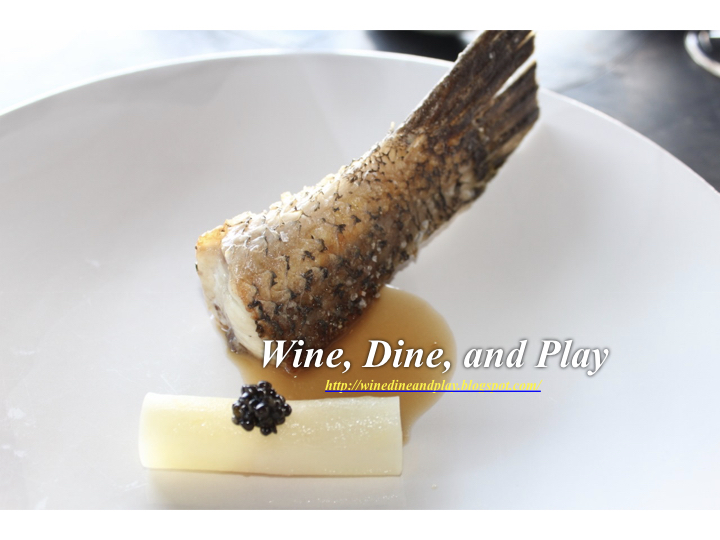
The next two courses on the menu, now going into my first hour of dining, and enjoying every minute of the experience was a barramundi tail with rolled potato, chicken sauce, and caviar. The barramundi has flesh which is a pearly-pink when raw and white when cooked. Barramundi or Asian sea bass as it is known has firm flesh with large moist flakes and a sweet, buttery flavor profile. The skin is also edible and crisps up nicely. 
Barramundi tail
The second course following the barramundi was the Blackmore Wagyu, served with pearl onion skins, and mustard greens, sautéed table-side, then drizzled with a wonderfully light flavored sauce. Blackmore Wagyu is an award-winning and internationally recognized producer of 100% Full-blood Australian Wagyu beef. 
Cooking the Blackmore Wagyu 
Wagyu presentation
It was now time for the intermezzo Course, starting with a nice glass of bubbly, NV Charles Heidsieck ‘Brut Reserve’ from Reims, Champagne. The winemaker explains that this particular blend of Pinot Noir, Pinot Meunier, and Chardonnay. A judicious selection of approximately 60 crus, 40% of reserve wines,  many of them more than 10 years old. A golden champagne, with persistent effervescence and a nose that is both complex and delicious. Crisp Palette with lush plum and ripe cherry. Things were really starting to get exciting. The Intermezzo was a cucumber sorbet with wood sorrel, but what made it exciting was that it was pumped with liquid nitrogen to make it super cold. I love Molecular Gastronomy!
Cucumber sorbet with liquid nitrogen
After the palate cleanser went down and cleared me out it was time to switch gears to a duck yolk salad, with smaller cubed pear pieces, and shaved black truffle. I usually don’t see black truffle on menus that often do to the price, with The French Laundry being the last place, and they charged an additional $100.00 to add it. 
Duck yolk salad with black truffle
The next course was homemade bread, with a unique service. Another stone was brought to the table, except this one was very warm, and a leather pouch made from kangaroo skin with the bread inside it was placed on top, to keep the bread warm. The butter served was a presentation in itself as the service staff brought over an old churning machine, and presented the made in-house butter. What is the main difference between this older method that has been around since 3500 B.C, versus just buying butter and making something with it? Butter must contain 80% minimum butterfat by United States law, while in France, butter must be composed of at least 82% fat. Home churned butter will be right up there in the 86-88% range. Commercial butter is a very uniform dispersion of water in oil, leaving out the true quality of home-style butter. After the churning, the server formed the butter into an oval shape and presented it for me to use on the bread.
Churning butter for bread
The next two courses changed course on wines requiring a 2011 Viognier from Jasper Hills Farm Cellars, ‘Georgia’s Paddock’ from Heathcote in central Victoria, a good two-hour drive or more north of Melbourne. The winemaker says that the beguiling honeysuckle scents and a fine straw color and classic aromas of honeysuckle and apricots arose the nose while there is the wonderfully expressive citrus-edged palate of white peaches and tropical fruit to finish. The first course with this group was a marron also better known as a Western Australian crayfish served with an almond-sugar pasted marzipan cracker, and brown butter. 
Western Australian crayfish
The next course was a spiny hedgehog of the sea, a.k.a sea urchin marron with corn, parson’s nose, which is the fatty extreme end portion of the tail of a fowl when cooked, also called the pope’s nose, served with caviar. 
sea urchin
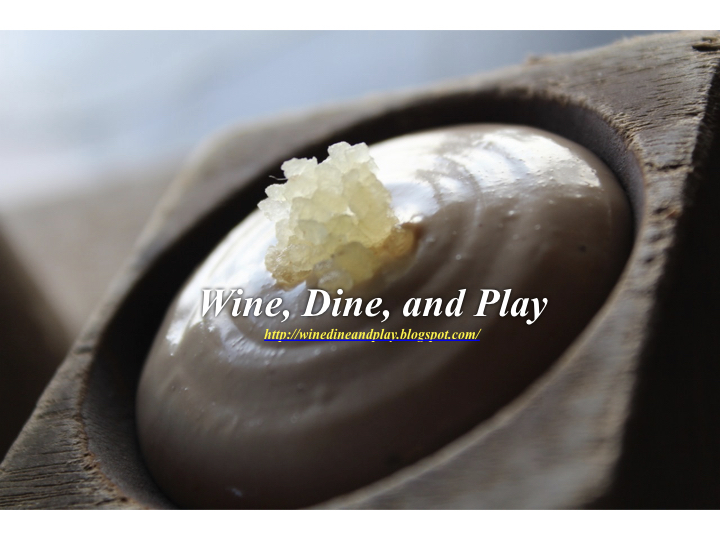
The final wine on the tasting list came with the final three courses, dessert, and petit fours. The tasting was of a 2014 Framingham ‘Noble’ Riesling from Marlborough, New Zealand, a very sweet low alcohol wine reminiscent of a good German dessert wine, or ice wine. The winemaker notes show that the wine is fermented in oak, blended from nine to ten components. Beerenauslese level. Very intense and luscious wine with masses of honeyed botrytis character plus dried apricot/nectarine and a suggestion of spice, pithy marmalade-like citrus, with hints of “gin and tonic.” A Long, powerful dessert wine with a perfect balance of sweetness and acidity preventing any sense of cloying and building terrific tension. The palate is tight but has richness and viscosity. Marmalade flavors, vibrant grapefruit citrus, and apricot with hints of mango and other tropical fruits; “pure” botrytis flavors.
Wine Regulatory’s from the tastings at Vu de Monde: 
COWA: The Central Otago Winegrowers Association, New Zealand
AGWA: Australian Grape and Wine Authority


Dessert:
The first dessert course was a strawberry swirl on a skewer, with a rhubarb and mint powder served on yet another rock. Very tasty but also tangy with blended powder, that went down nicely with the Riesling.
Strawberry Swirl
The second dessert, and by far the best-looking presentation of the meal, in my opinion, was the Chamomile, sugar, and lime served in a seared then chilled mango, an absolutely stunning flavor that felt like a second palate cleanser.  
Mango dessert
The third and final dessert course was a chocolate soufflé with a powdered sugar. Classic dish put refreshing theme that fit the entire meal. Finally after finishing the wine, and the third dessert, a selection of four petite fours were brought out, to include a wrapped chocolate on the edge of a spoon called ‘the one penny,’ a traditional Australian dessert called ‘flip the penny,’ a game and treat going back over one hundred years. The other selections included caramel candy served on seashells, cherry covered in cubed coconut. Pork skins in white chocolate. You also had the option to add cheese to your course if you wished, and all the local cheeses were kept in a cart, pushed out and the presentation is done tableside.
Chocolate soufflé
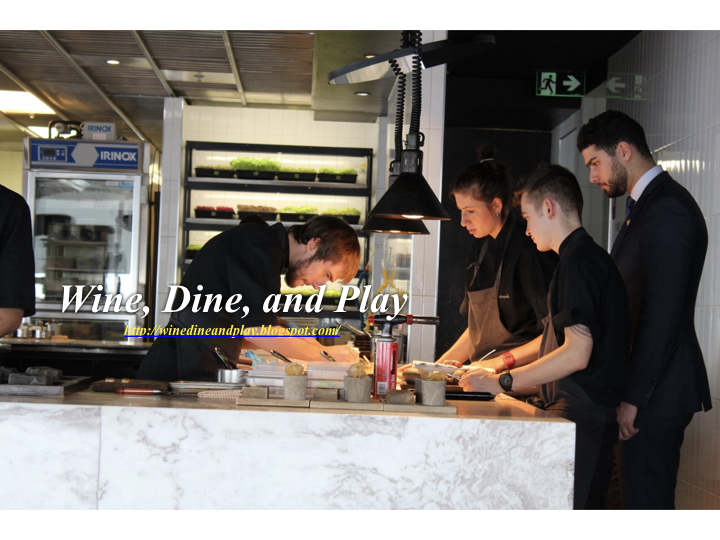
During this time I took my second tour of the kitchen, wine cellar, and was introduced to the rare artwork and given an introduction to it. Since I was in food service, the management extended the kitchen tour to me, seeing the inner belly of the beast that most guests did not get to see. When I returned to the table, they had a little bag on the table with some goodies for me to take home, to include bread with honey, cookies, and mixed nuts. As a closing to a perfect lunch the kitchen crew invited me over for a group picture, and some guests also joined in with the picture. 
Bag of treats
By the way, the rocks, wood, seashells, and kangaroo leather bread holder which was the main theme of every course was a representation of Australia and its diversity. 

Please see these guidelines for Tipping in Restaurants and on following proper etiquette, customs, cultures, and avoiding assumptions when you dine out.

Other Noteworthy Molecular Gastronomy Articles & Restaurants:
Alinea Highly creative new American molecular gastronomy tasting menus in Chicago, Illinois
Edison Food + Drink Lab Eclectic & innovative gastropub using molecular gastronomy in Tampa, Florida
Qui Restaurant Eclectic global plates and sushi in Austin, Texas (name changed to Kuneho)

See the whole list by visiting “The Wine Dine and Play Article Glossary


Other Melbourne restaurants and articles on Wine, Dine, and Play:

An innovative and eclectic tasting menu
 Ripponlea, Australia
A top 20 on Wine Dine and Play

Rustic café for Modern Australian
Melbourne, Australia
Two city-block landmark market
Melbourne, Australia


A Few Australian Favorites:

Eclectic French-Asian Tasting Menu
Sydney, Australia
A top 20 on Wine Dine and Play
Seasonal Northern Italian at the De Bortoli Winery
Yarra Valley, Australia
Quintessential Modern Australian Cuisine 
 Sydney, Australia
A top 20 on Wine Dine and Play
Yearly tasting event at Hyde Park
Sydney, Australia
Modern Australian haute cuisine
Sydney, Australia
Creative modern Australian dining
Yarra Glen, Yarra Valley Australia


See the whole list by visiting “The Wine Dine and Play Article Glossary by country


Final notes, review basics, observations and more pictures:

Most reviews are subjective, depending on the writer; but they should also be responsible, and respectfully written, upholding the truth, and accurately conveying the experience to the best of the writer's knowledge, even if it includes metaphors the restaurant may not like to read about. My ratings are by the stars I award (from 0 to 5). The rating is calculated on a point accumulation of six separate factors based on individual experience. They include wine and other beverage selections, plate presentation, customer service, restaurant or café ambiance, food quality, and wow factor. To see more details of this rating list, read this article:

Overall from this experience and the score factors outlined in the ‘about page’ section, based on my individual experience and rating, I give Vue de Monde a 5 out of 5 stars, meaning that they not only exceeded my expectations and were far above the average dining experience of most restaurants, but they surpassed outstanding and were extraordinary.
Scores are detailed in the factor chart below:

Formula Factor Conclusions and Overall Ratings
Max Points Possible:
Total Points Awarded:
Total Points deducted:
Ambiance
10
10
0
Food quality
10
10
0
Plate presentation
10
10
0
Customer service
10
10
0
Alcohol and other beverages
10
9
1
Total regular points awarded
50
49
1
Total percentage Before Bonus

0.98

“Wow” factor BONUS
5
5
0
Total bonus percentage

0.1

Total percentage with a bonus for the final star rating

1.08

Stars Awarded (see chart below)
             0 - 5
5

**A full break down and explanation of the observations and point disbursement is available in the linked article above. To receive a detailed copy of your score, feel free to contact me at any time and I will provide it to you.**


***

Overall Star Rating:
5 of 5 Stars: 
108% Rating with a 5 point “wow” bonus
An Extraordinary Dining Experience
Wine List:
Wine rating:
9 of 10
Old World selections: 
Austria, France, Germany, Italy, Spain

New World selections: 
Argentina, Australia, California, Canada, Chile, New Zealand, Oregon, South Africa, Washington State
Corkage fee’s:
This Restaurant does not list any corkage fee’s however, most American restaurants charge 
$25.00 per bottle
Restaurant style:
Formal dining
Cuisine style:
Australian
Allergen or dietary accommodations: 
Farm to Fork, Gluten Free, Grass Fed, Local, Low Carb, Organic, Pescatarian, Sustainable, Vegetarian Options
Reservations:
Required
Walk-Ins:
Not accepted
Dress code:
Formal or, Semi-formal attire
Gentleman – Dress Coats, Dinner Jackets, or Smart Business Attire
  Ladies – Semi Formals, Cocktail Dresses, or Formal Gowns
Child policy:


The Restaurants reviewed on this site may have a kids menu or cater to them; however, for full enjoyment of food and wine, it is recommended that kids not to be in attendance, unless they have been trained in proper etiquette. 
If not then:
Hire a Babysitter! 
Experiences:
Place for foodies, Contemporary, Modern, Trendy, Lounge, Business parties, Romantic, Hotspot, Great bar, Good for special occasions, Beautiful décor, Scenic views, Intimate, Classy, Upscale, and a Neighborhood Gem.
Payments:
Cash, Visa, MasterCard, Discover, American Express
Parking:
Valet or private lot
Valet $50.00 AUS, Private lot $15.00 AUS p/hour
Wifi
The restaurants reviewed on this site may have Wi-Fi, but do not require you to go online, because the excitement of the food and wine alone will keep you too entertained instead of checking your social media and emails.
Noise level:
Low to Medium
Smoking:
Nonsmoking restaurant
Patio or terrace:
No


Food Prices 
(excludes, alcohol, taxes & 20% gratuity’s)

$£€¥ -                Under 50.00 (inexpensive)
$£€¥ x 2 -          51.00- 99.00 (moderate)
$£€¥ x 3 -          Over 100.00 (pricey)
$£€¥ x 4 -          Over 200.00 (expensive)
$£€¥ x 5 -          Over 400.00 (very expensive)


**Currencies reflect the world’s major travelers, restaurant, or wine connoisseur’s**

Currency:
Price
Australian Dollar (AUS)
$$$$
United States Dollar (USD)
$$$$
Great Britain Pound Sterling (GBP)
££££
Canadian Dollar (CAN)
$$$$
Chinese Yuan (CNY)  
¥¥¥¥¥
European Union (EUR)
€€€€

 Alcohol prices:

$129.00 AUS


Vue de Monde:

Level 55, Rialto
525 Collins Street, Melbourne VIC 3000


Contact Information: 
Restaurant website:
Maître d or host:
+61 3 9691 3888
Online reservations
Email Contact:
Serving hours:
Eastern Australian Standard Time
(GMT, Zulu, or UTC + 10:00)
Lunch: Thur-Sun
12:00 pm - Midday
Dinner: Mon-Sun
6:00 pm - 9:00 pm
Social Media 
Accolades:
Facebook Link                


****
The worlds best restaurants is a subjective list of who is writing it and changes on a regular basis. The Wine Dine and Play best experiences are based on my highest rated stared restaurants, meaning that the visit was an outstanding or extraordinary experience. From cafés, chains, mom + pops, hole in the walls, to fine dining including a few Michelin spots. Visit the Top 100 page to see the entire list.


A few to tease you with…

Rodízio buffet and churrascaria
 Niagara, Canada
Dessert shop with Southern treats, and praline
Savannah & Charleston, South Carolina, USA
German Bites in Bavarian-style Tavern 
Ruskin, Florida, USA


Other Pictures:

Italian immigrant sculptures
Views of Melbourne from the Lui Bar 
Toolangi Vineyards of Yarra Valley 
Christofle flatware
Smoked eel, with white chocolate and caviar
Cured Wallaby
Assorted starters 
West Pacific oyster 
Wagyu steak flatware setting
Kitchen action
Kitchen expedition line
Kitchen tour
 
 
Rock bowl
Wagyu presentation
Intermezzo cucumber sorbet with wood sorrel
Black Truffle
Kangaroo Bread warming pouch
Butter churner 
 
Viognier from Jasper Hills Farm Cellars 
Almond-sugar pasted marzipan cracker
Sea urchin
Four petite fours 
‘Flip the penny’ 


Wine cellar


Hugo Simoes Santos - Dining Manager
Matthew Lamb - Sommelier 


“Culinary perfection consists not in doing extraordinary things, 
But in doing ordinary things extraordinarily well.”

-Angelique Arnauld (1591-1661)


Who is John Galt?


TTFN


Related Posts Plugin for WordPress, Blogger...

You may also like:

View my food journey on Zomato!

Popular Posts: